Beyond the Dashboard: Reaching Autonomous Network Level 4 (ANL4) with Real-Time Sensing and Intelligent Orchestration
 The telecommunications industry is at a critical inflection point. As Communication Service Providers (CSPs) roll out 5G standalone architectures, edge computing, and network slicing, the complexity of the underlying infrastructure has skyrocketed. Yet, while the networks themselves have evolved exponentially, the operational paradigms managing them have often lagged.
To deliver the ultra-reliable, low-latency connectivity demanded by modern enterprise and consumer applications, the telecom industry must move beyond reactive management. The destination is clear: Autonomous Network Level 4 (ANL4), where networks self-monitor, self-optimize, and self-heal with minimal human intervention.
Achieving this level of autonomy is not a distant sci-fi pipe dream, nor does it require ripping out your existing infrastructure. It relies on a powerful, joint approach: combining hyper-accurate Real-Time Sensing with Intelligent Orchestration.
In this blog, we will explore how CSPs can break the bottleneck of manual operations and transition to production-grade network autonomy.
The Bottleneck of Manual Operations
For decades, network operations have relied on a fundamentally reactive model. Traditional Network Management Systems (NMS) and Operational Support Systems (OSS) rely on polling mechanisms – like SNMP traps or syslog data – that might only update every five to fifteen minutes.
In today’s high-stakes connectivity environment, a five-minute visibility gap is an eternity.
When a fault occurs, operations teams are hit with a flood of disparate alarms. Network engineers are forced into “swivel-chair management,” frantically pivoting between isolated vendor dashboards to correlate events, identify the root cause, and manually execute remediation scripts.
This manual, reactive approach presents three critical bottlenecks:
- Unacceptable Latency in Remediation: By the time a human operator correlates an alarm and acts, the customer has already experienced a service degradation or outage.
- The “Grey Failure” Blind Spot: Traditional monitoring is great at telling you when a fiber is cut (a hard failure). It is terrible at detecting “grey failures”- subtle micro-bursts, packet loss, or latency jitter that silently destroy the user experience without triggering a hard alarm.
- Unsustainable OPEX: You cannot scale human operations linearly with the exponential growth of 5G network complexity. Alert fatigue is real, and relying on human intervention for routine optimization is economically unviable.
To survive, CSPs must transition from a model of monitoring after the fact to sensing and acting in real-time.
The Power of ‘Sensing’: Real-Time Detection and Active Probing
You cannot automate what you cannot see. The foundation of ANL4 is highly granular, real-time observability. But passive monitoring is no longer enough; the network must be actively monitored.
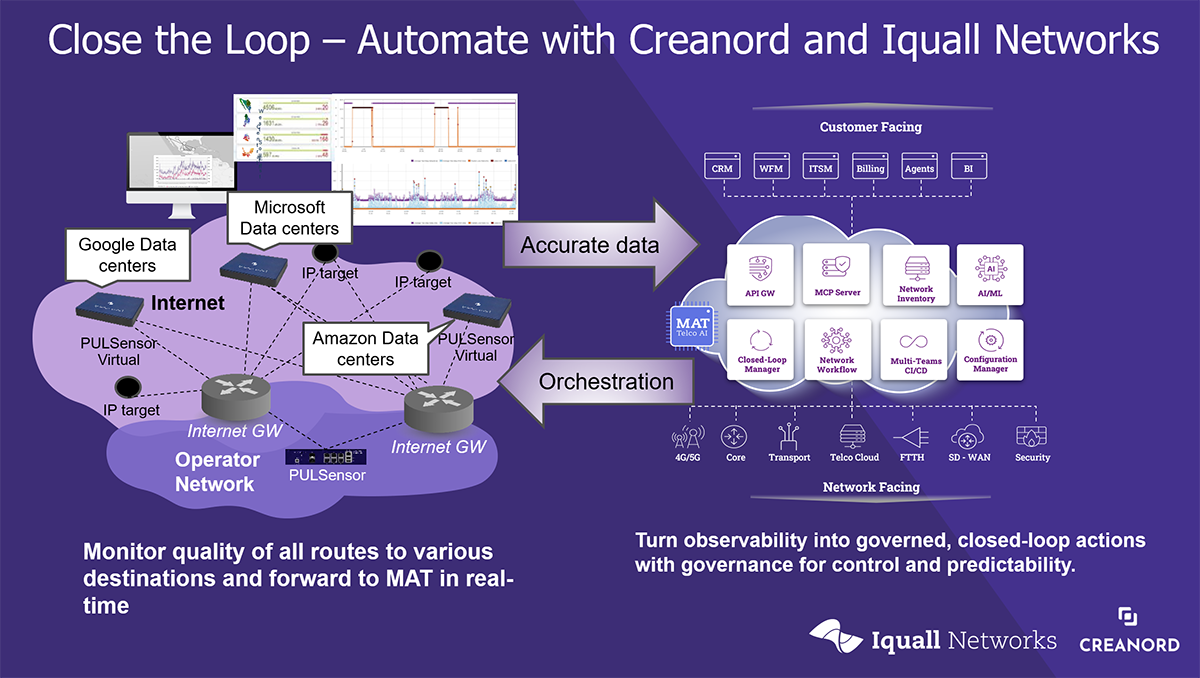
This is the power of ‘Sensing’. It involves deploying active, carrier-grade probing across the network fabric to continuously measure end-to-end performance. By utilizing protocols like TWAMP (Two-Way Active Measurement Protocol), CSPs can inject synthetic test packets into the data plane, mimicking actual user traffic.
This active sensing must operate at extreme fidelity. We are no longer talking about millisecond estimates; true ANL4 requires microsecond-level accuracy.
- Proactive vs. Reactive: Active probing detects performance degradation before the customer notices. It identifies the subtle increases in jitter or the fractional drop in packet delivery that precede a major service impact.
- True QoS Visibility: By continuously sensing the network state, operators gain an unbroken, real-time view of Quality of Service (QoS) across multiple domains, from the RAN to the core and out to the edge.
However, sensing is only the first half of the equation. If you generate microsecond-level telemetry but still rely on a human to interpret it, you have only created an incredibly fast, very expensive dashboard.
The Magic of ‘Acting’: Intelligent Orchestration
The true magic of ANL4 happens when you close the loop. If sensing is the nervous system, Intelligent Orchestration is the brain and muscle.
Intelligent Orchestration involves feeding the high-fidelity, real-time data generated by active probes directly into an AI-driven orchestration engine. Instead of triggering a dashboard alert for a human to read, the orchestrator acts on the data autonomously based on pre-defined policies and machine learning algorithms.
When the sensing layer detects a performance degradation – say, latency crossing a strict SLA threshold – the orchestrator instantly calculates an optimal alternative path and triggers an automated, closed-loop remediation. It can reroute traffic, adjust QoS policies, or spin up additional virtual network functions in milliseconds.
The “Brownfield” Advantage. One of the most persistent myths in the telecom industry is that achieving ANL4 requires a massive, risky “rip-and-replace” of legacy systems. This is simply not true.
Modern intelligent orchestration is designed to be overlaid on top of brownfield environments. Using open APIs and standardized frameworks (like those defined by the TM Forum and MEF), an orchestration engine can interface with multi-vendor, cross-domain networks. It seamlessly commands legacy BSS/OSS systems, SDN controllers, and disparate vendor hardware, translating high-level business intents into device-level configurations. You don’t have to rebuild your network; you just have to connect its existing parts to a smarter brain.
Real-World Impact: Optimizing the Internet User Experience
To understand the tangible value of this joint approach, consider the critical challenge of internet peering and routing optimization.
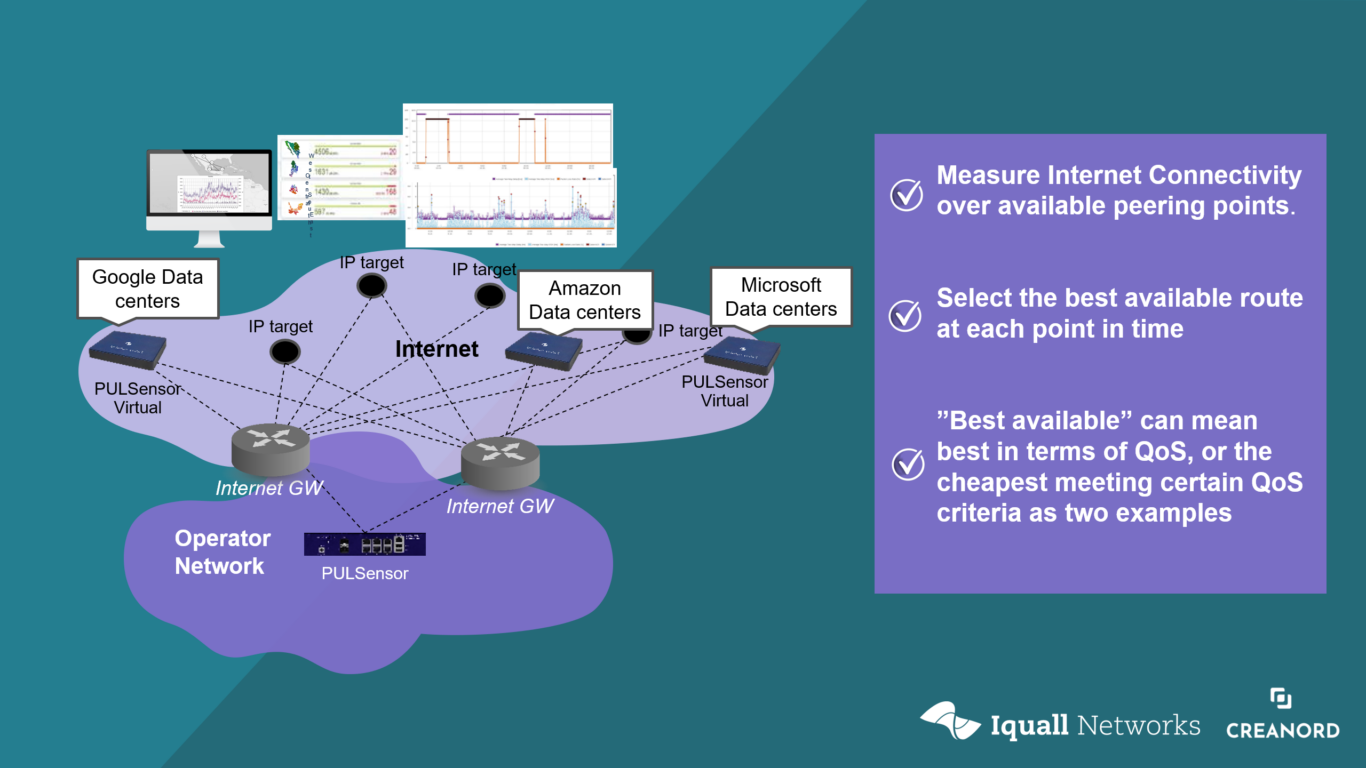
The Scenario: A CSP is routing high-value enterprise traffic across a specific peering transit link. Suddenly, the transit provider begins experiencing micro-outages and severe packet loss. Because the BGP (Border Gateway Protocol) session hasn’t completely dropped, traditional monitoring tools see the link as “UP.”
The Manual Reality: Customers begin complaining about terrible application performance. NMS dashboards are green. Engineers spend hours running traceroutes, eventually identifying the faulty peering link, and manually adjusting BGP local preference to shift the traffic. MTTR: 2 to 4 hours.
The ANL4 Reality (Sensing + Acting): 1. Sensing: Active TWAMP probes running across the peering link detect the microsecond-level packet loss the moment it begins. 2. Correlating: The telemetry is instantly streamed to the Intelligent Orchestrator, which recognizes an SLA violation for the enterprise traffic. 3. Acting: The orchestrator queries the network topology, identifies the next-best peering route that meets the SLA criteria, and autonomously pushes a configuration change to the network to reroute the traffic. 4. Result: The traffic is cleanly shifted. MTTR: Under 3 seconds. The enterprise customer never even perceives a drop in their user experience.
Conclusion: The Mandate for Integrated Autonomy
The transition to Autonomous Network Level 4 is no longer a luxury for CSPs; it is an operational imperative. The combination of Real-Time Sensing and Intelligent Orchestration fundamentally transforms the economics and reliability of telecom networks.
By closing the loop between microsecond-level detection and AI-driven automated remediation, CSPs unlock massive business benefits:
- Drastic OPEX Reduction: Freeing engineering teams from manual alarm correlation and routine firefighting.
- Near-Zero MTTR: Resolving degradations in milliseconds or seconds, rather than hours.
- Bulletproof SLAs: Guaranteeing enterprise-grade performance and paving the way for advanced monetization models like network slicing.
It is time to step away from the swivel chair and look beyond the dashboard. Moving from isolated monitoring to integrated, production-grade autonomy is the only way to scale the networks of tomorrow. Assess your current fault management processes today, and begin identifying the domains where closed-loop, active orchestration can deliver immediate, transformative ROI.