The Future is Here: Navigating the 5G Era of Mission-Critical Networks
 The era of relying solely on legacy TETRA networks is behind us. While these systems have been the reliable backbone for first responders and critical communications for years, they simply cannot handle the data-heavy demands of modern broadband services. Today, operators are rapidly transitioning to resilient, high-capacity 4G and 5G architectures to future-proof their operations. This vital shift unlocks a wealth of next-generation capabilities, empowering agencies with advanced tools like augmented reality for firefighting, remote eHealth diagnostics, drone-assisted situational awareness, and seamless group video conferencing.
As we look at the industry landscape in 2026, Sweden’s transition to the Swedish Emergency Network (SWEN) perfectly illustrates this monumental shift. Phasing out the legacy Rakel system by 2030, SWEN adopts a brilliant hybrid architecture that combines a state-controlled core network with commercial 4G and 5G mobile networks. This approach ensures vast national coverage and unlocks advanced broadband capabilities, but it also highlights a critical operational reality: guaranteeing uncompromised service assurance across shared and hybrid infrastructures is paramount.
The Hybrid Challenge: Assurance is Non-Negotiable
As critical communication network providers migrate to commercial 4G/5G technology, they must ensure that the new networks and applications meet the same availability targets as the existing TETRA networks. Traditional network monitoring tools no longer meet the requirements; an advanced end-to-end service assurance platform is needed to get the required insight into the performance of the network.
In modern hybrid setups, traffic flows across both commercial radio access networks (RAN) and government-controlled cores. In addition to monitoring the end-to-end service performance, the service assurance tool needs to monitor the performance individually for four distinct segments in the network:
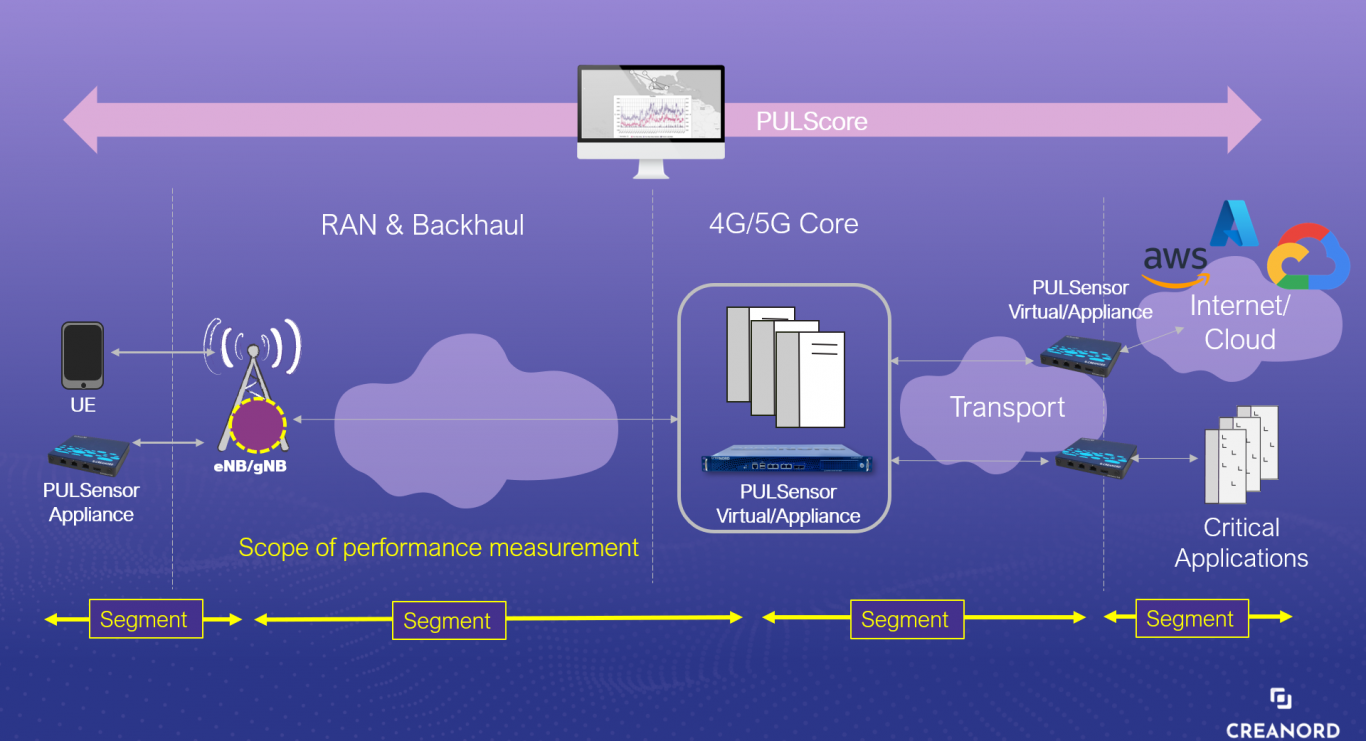
- User Equipment to Base Station (Radio Performance): A primary bottleneck for service quality often lies in radio coverage. Typically, commercial RAN operators design their networks to maximize coverage in densely populated urban centers where their paying subscriber base is highest. However, mission-critical providers require unwavering, consistent performance across both cityscapes and remote rural environments—and often lack visibility into how commercial radio planning aligns with these strict operational needs. By leveraging the end-user’s equipment to actively measure application and radio performance, critical network operators can bridge this visibility gap and collaborate effectively with RAN providers to pinpoint and resolve coverage dead zones.
- Base Station to 4G/5G Core (Mobile Backhaul): In a hybrid model, critical communication traffic is routed through shared backhaul infrastructure. Although specialized service classes prioritize this data, the reality of mixing varied traffic types across a patchwork of fiber and radio links means that guaranteed performance isn’t a given. To mitigate this risk, critical communication agencies must establish agreements with RAN operators to actively monitor the backhaul connection with TWAMP. By enabling TWAMP reflection features on cell site routers and base stations, network operators can gain continuous, precise visibility into the backhaul health directly from the 4G/5G core.
- Internal Transport Network: Many critical communication providers maintain proprietary transport networks to link 4G/5G core sites to essential applications hosted in public clouds, the Internet, or private data centers. Often, these legacy transport networks were not architected to absorb the massive data surges generated by modern, bandwidth-heavy applications like real-time video streaming. Deep visibility into this segment is non-negotiable; it empowers operators to proactively monitor network strain and strategically upgrade capacity before bottlenecks impact the end user.
- Connectivity to Critical, Public Cloud, and Internet Applications: To achieve a truly holistic view of service health, monitoring must extend all the way to the application layer. Whether these mission-critical applications are hosted on the open Internet, in public clouds, or within highly secure private data centers, tracking their performance is essential. This comprehensive data allows network teams to accurately correlate end-to-end application slowdowns with specific degradations occurring between the application servers and the edge of the transport network.
Embracing the Future with Confidence
The migration of critical communication networks from TETRA to 4G/5G-based architectures is ongoing in many countries around the world, with a promise of delivering many new and beneficial use cases. To be successful in the migration, critical communication providers need to carefully consider how they are monitoring their networks in order to ensure they have the visibility and tools to fix potential service performance issues, preferably in a proactive way rather than a reactive way.
As nations like Finland and Sweden lead the charge into the resilient 5G era for mission-critical communication, we stand ready to ensure these vital lifelines remain unbroken. Visit www.creanord.com and contact us to find out more about how we can help you build outperforming networks.
About Creanord
Creanord is a specialist in service assurance with more than 25 years of experience in developing solutions for network service providers and cloud providers. Creanord’s service assurance solutions enable accurate tracking of network and application quality and performance, and the technology has been implemented in over 30 countries and more than 60 networks globally.