Zero Tolerance for Downtime: Why Energy Networks Rely on TWAMP for Private 450 MHz Assurance
 The energy sector is undergoing a massive transformation. As we shift toward decentralized renewable energy, widespread electric vehicle adoption, and highly automated smart grids, the flow of data has become just as critical as the flow of electricity. To control the grid in real-time and reliably read millions of smart electricity meters (AMI), utilities require a communications infrastructure they can fully trust.
Increasingly, the answer is not relying on public commercial networks, but rather building dedicated, private mobile networks. By owning the Radio Access Network (RAN) and core, utilities gain total control over power backup, maintenance windows, and security, ensuring grid operations remain resilient even during severe storms or regional blackouts.
Why 450 MHz is the Gold Standard
When building these private networks, spectrum is everything. The 450 MHz band (LTE-450) has rapidly emerged as the de facto standard for critical utility communications.
Because it is a low-frequency band, 450 MHz provides massive geographical coverage, requiring far fewer cell towers to blanket remote and rural infrastructure. Furthermore, it offers exceptional signal penetration reaching deep into basements and underground meter rooms where higher-frequency signals simply cannot go.
This momentum is heavily championed by the 450 MHz Alliance, an organization doing incredible work to foster a global, standardized ecosystem. Thanks to their efforts, utilities now have access to mature, certifiable devices and network equipment, ensuring 450 MHz deployments are not just technically superior, but commercially viable and future-proof.
The “Best Effort” Trap in Critical Infrastructure
While 450 MHz provides the physical foundation, running a mission-critical utility network requires a fundamental shift in how performance is measured. In grid automation and control, “best effort” connectivity is unacceptable. These systems often demand latencies below 10 milliseconds and availability exceeding 99.999%. A transient micro-outage might be a minor annoyance on a commercial smartphone, but on the energy grid, it can destabilize power distribution.
To guarantee these stringent Service Level Agreements (SLAs), utilities must move beyond traditional, passive network monitoring techniques. You cannot secure the grid by simply reacting to equipment failures; you need to see network degradation before it impacts operations.
Enter TWAMP: The Defacto Standard for Active Monitoring
This is where the Two-Way Active Measurement Protocol (TWAMP) comes in. Standardized by the IETF (RFC 5357), TWAMP is the industry’s most robust and widely supported protocol for high-precision, end-to-end IP network performance monitoring.
Unlike passive monitoring, which simply observes traffic, or basic pings that lack accuracy, TWAMP continuously injects active test packets into the network. It measures round-trip and one-way performance with microsecond-level precision, acting as a continuous, proactive heartbeat for the grid.
.
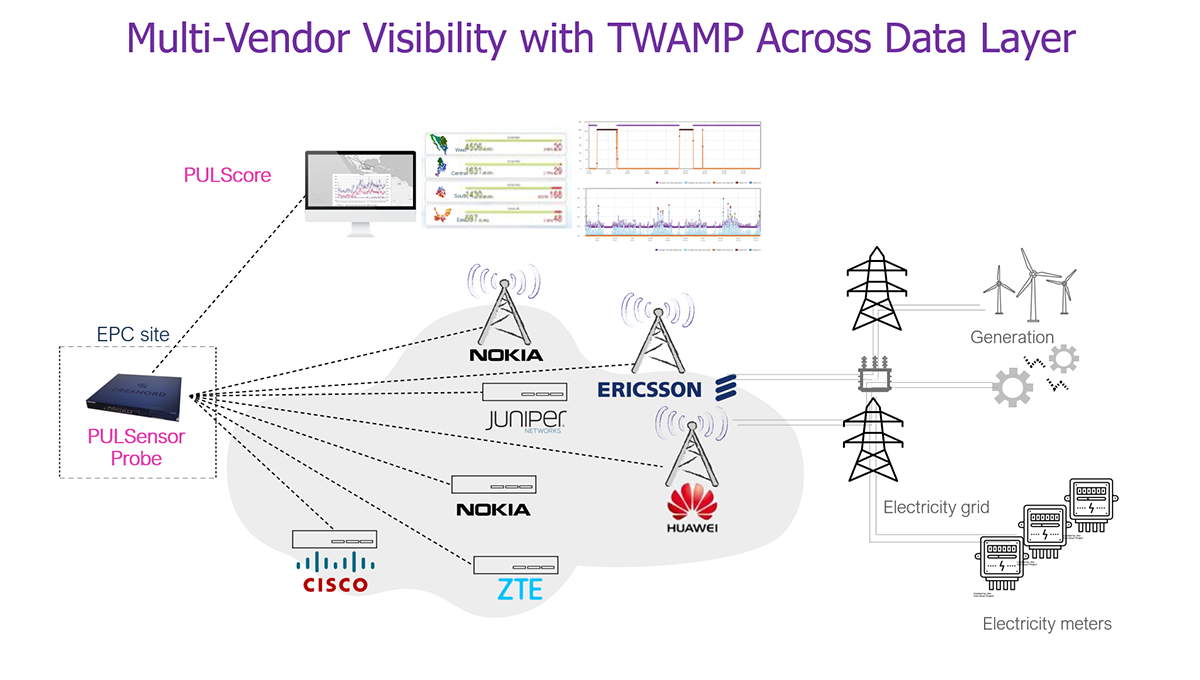
The Benefits of Active Monitoring in Energy Networks
Deploying a centralized, TWAMP-based active monitoring solution provides energy providers with several transformative advantages:
- Multi-Vendor Visibility: TWAMP is heavily supported across major network element vendors. A centralized probe can leverage built-in reflector functionality in existing utility routers and gateways, providing a unified, end-to-end view across the entire multi-vendor transport network.
- Cost-Efficient: Since the TWAMP protocol allows you to use the network equipment itself as reflectors, you only need to install one or a few centralized probes in order to obtain a full view of the entire network infrastructure. TWAMP reflection can be enabled in the sites remotely through the vendor EMS or command line interface utilities, and thus, costly site visits can be avoided.
- Consistency: Installing an active monitoring TWAMP solution immediately provides you with a consistent data view across the entire transport, as standardized protocols are used and the centralized probes already provide consistent data for all data connections. If you collect data from a number of different vendor EMS systems, the data needs to be processed in order to be consistent, often by sacrificing the accuracy of the data set. With centralized TWAMP monitoring, you know you can trust your data from day 1.
- Validated Resilience: Active monitoring proves that the network is doing what it was built to do. It generates objective data to confirm that mission-critical traffic is receiving the correct Quality of Service (QoS) prioritization over less critical data. This can further be combined with SLA reports over multiple periods, days, weeks, or months to provide proof that the network is delivering connectivity as required.
Securing the Future of the Grid
Creanord has spent decades building carrier-grade service assurance solutions for the world’s most demanding telecommunications providers. Today, energy networks have become just as complex and arguably more critical. As utilities continue to deploy private 450 MHz networks to modernize the grid, active TWAMP monitoring is no longer a luxury; it is a necessity. By turning actionable data into outperforming networks, we can ensure that the lights stay on, the data keeps flowing, and the smart grid lives up to its full potential. To learn more, please contact us at sales@creanord.com.
About Creanord
Creanord is a specialist in service assurance with more than 25 years of experience in developing solutions for network service providers and cloud providers. Creanord’s service assurance solutions enable accurate tracking of network and application quality and performance, and the technology has been implemented in over 30 countries and more than 60 networks globally.