The Green Energy Transition Has a Hidden Single Point of Failure
 A renewable grid is only as reliable as the communications network that controls it. And you can only trust that network if you measure it continuously in a similar way your grid applications experience it.
For most of the last century, the power grid was a one-way street.
Large thermal plants generated electricity, transmission lines carried it, and distribution networks delivered it downstream to passive consumers. Load was predictable, and generation was dispatchable. The communications network sitting behind it all had a relatively relaxed job: carrying slow SCADA polls to a handful of substations.
That grid is gone.
Today, electrons flow in both directions. At noon, rooftop solar on a quiet suburban street can push a feeder into reverse power flow. A passing weather front can wipe out a major share of a wind farm’s output in minutes. A battery storage park 100 kilometres away is expected to halt that frequency dip within a fraction of a second.
We often talk about the grid’s communications network as its central nervous system. Right now, that nervous system is being asked to execute reflexes at speeds current monitoring simply was not built to prove.
Here is what the physics of the energy transition actually demands from utility networks in milliseconds and percentages, and how utility leaders can prove, every single day, that their network can deliver it.
Why Renewables Turn the Control Network Into a Real-Time System
Transitioning from fossil fuels to renewable energy doesn’t just change how we generate power; it fundamentally changes the physics of grid stability in three ways:
- Natural inertia is disappearing. Traditional synchronous generators store massive kinetic energy in their rotating turbines, naturally slowing down frequency deviations and giving operators seconds to react. Inverter-based resources solar PV, modern wind turbines, and batteries provide little to no natural inertia. As their share of generation grows, the rate of change of frequency after a disturbance accelerates. The window for corrective action is shrinking from seconds to hundreds of milliseconds. Fast frequency response and synthetic inertia schemes work only if the activation signal arrives strictly on time.
- Generation is volatile and hyper-distributed. Instead of dispatching a few dozen thermal plants, operators must now orchestrate thousands of distributed energy resources (DERs): PV inverters, wind parks, battery storage, heat pumps, EV chargers, and demand-response aggregations. When cloud cover sweeps across a region, a DER management system (DERMS) must curtail, dispatch, or rebalance thousands of assets simultaneously. Each command and every telemetry reading lives or dies on the communications network.
- Grid protection is now communication-assisted. Bidirectional power flows and low fault currents from inverters break traditional overcurrent protection assumptions. Utilities are countering this with communication-assisted schemes: line differential protection, permissive and blocking transfer trip, adaptive protection settings, and anti-islanding intertrips.
The takeaway for utility executives and chief engineers is stark: the communications network is no longer an IT support system for the grid. It is inside the physical control loop. If the packet is late, the breaker is late.
The Millisecond Budget: What the Grid Actually Demands
Talking to utility engineers, the conversation is no longer around “Is the link up?” Rather, it is about: “What is the delay budget for this application, and how do we prove we are inside it?”
Drawing from IEC 61850 and IEEE C37.118, here are the engineering boundaries the modern grid operates within:
|
Grid Application |
One-Way Latency |
Jitter / Delay Asymmetry |
Packet Loss Tolerance |
|
Line differential protection |
5 – 10 ms |
Asymmetry well below 1 ms; highly stable delay |
Effectively zero |
|
Teleprotection & transfer trip |
10 – 20 ms |
Low and bounded |
Effectively zero (a lost trip is a failed trip) |
|
Wide-area protection & control |
20 – 50 ms |
Low (late samples are discarded) |
Very low (lost samples create blind spots) |
|
Fast frequency response & DER dispatch |
100 ms – 1 s |
Moderate |
Low (repeated loss delays activation) |
|
SCADA & telemetry |
100 ms – 1 s |
Moderate |
Low (causes retries, timeouts, stale control room data) |
|
Distribution automation |
Hundreds of ms – a few s |
Moderate |
Low |
|
Smart metering |
Seconds to minutes |
Tolerant |
Tolerant (recovered via retransmission) |
Look closely at that table, and two operational truths jump out:
- The most critical applications don’t care about bandwidth; they care about determinism. A protection message is tiny. It doesn’t need a massive pipe; it needs low, stable, symmetrical delay and zero packet loss. A link that averages 8 ms of latency but spikes to 40 ms during a microburst or radio retransmission will trip up a protection scheme while every traditional network dashboard stays glowing green.
- Everything shares the same physical pipe. Smart metering bursts, firmware updates, and field-crew video feeds now ride across the same transport infrastructure as teleprotection and DER control. Quality of Service (QoS) configurations are designed to keep them separated. But QoS configuration is a promise, not a measurement. Only continuous measurement proves that promise is being kept.
Why Traditional “Green Light” Monitoring Fails the Grid
Most utility networks are monitored passively. Element managers poll interface counters, CPU loads, and device alarms every few minutes.
That tells you whether a router is alive. It tells you nothing about what a SCADA poll or a transfer trip command actually experienced on its journey across the network.
Active monitoring flips the paradigm. By injecting lightweight, standardised test packets continuously along the exact same paths and inside the exact same QoS classes as live grid traffic, active monitoring timestamps every packet at both ends. It measures one-way delay, two-way delay, jitter, delay asymmetry, and packet loss per path and per traffic class.
For energy networks, this solves three blind spots simultaneously:
- It measures the service, not just the box: Test streams mirror the exact Class of Service (CoS) of protection, SCADA, or AMI traffic.
- It catches sub-second microbursts: Granular, sub-second test intervals catch the transient latency spikes and micro-outages that 15-minute SNMP averages completely smooth over.
- It creates a “Birth Certificate” and lifelong health record: Using open standards like ITU-T Y.1564 at commissioning verifies a link against its SLA before live grid traffic ever touches it, while TWAMP (IETF RFC 5357) provides 24/7 operational assurance thereafter.
Instead of discovering a degraded backhaul link after a protection alarm fires or a SCADA poll times out, operations teams spot creeping jitter trends days in advance and fix them before the grid ever feels it.
Control Network Availability Is Grid Availability
There is an inescapable chain of logic that every utility board and regulator now confronts:
- If the power grid must be available, the systems that control and protect it must be available.
- If those systems depend on the communications network, the communications network must be at least as available as the grid itself.
Mission-critical utility networks are routinely engineered for 99.999% (“five nines”) availability, allowing just 5 minutes and 15 seconds of downtime per year. Dropping to “four nines” (99.99%) sounds negligible on paper, but it opens the door to 53 minutes of unavailability. In a high-renewables grid, that gap is the difference between a non-event and a major regulatory investigation.
And regulators are no longer treating reliability as a “best-effort” engineering target:
- In Finland: The Electricity Market Act mandates that distribution networks withstand storms and snow loads without causing outages exceeding 6 hours in urban/zoned areas or 36 hours in rural areas, with binding deadlines closing in 2028 and 2036.
- Across the European Union: The NIS2 Directive places electricity transmission and distribution operators, producers, and market participants squarely under strict legal obligations for risk management, business continuity, and incident reporting across their operational networks.
- In the UK, North America, and Australia: Performance-based regulation directly ties allowed utility revenues and steep financial penalties to outage frequency and duration.
When an auditor, regulator, or board asks you to prove the availability of your grid control capability after an incident, “Our routers didn’t reboot” is no longer an acceptable defence.
Active monitoring produces continuous, time-stamped forensic proof that every critical path met its latency, jitter, and loss thresholds and shrinks root-cause analysis from days of vendor finger-pointing to minutes.
Breaking the Cost Barrier: One Central Probe, Thousands of Paths
Whenever I discuss end-to-end active monitoring with utility leaders, the first objection is almost always economics: “We have hundreds of substations, base stations, and remote sites spread across thousands of square kilometres. We cannot afford the CAPEX or the truck rolls to install dedicated hardware probes at every edge site.”
Here is the good news: you don’t have to.
Because TWAMP is an open standard built natively into virtually all modern base stations, cell-site routers, substation routers, and carrier Ethernet CPEs, the equipment already sitting in your field sites can act as TWAMP reflectors.
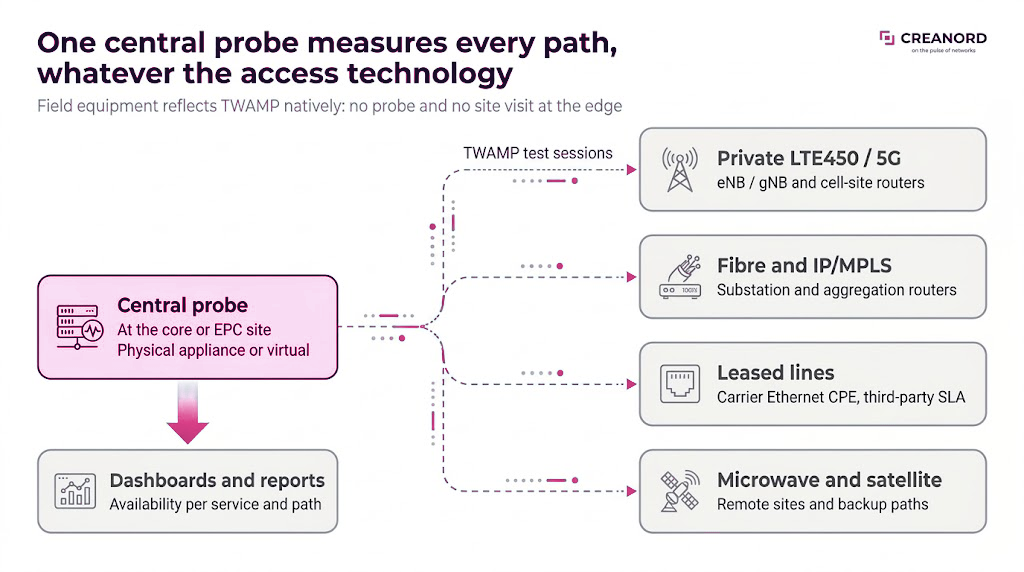
By deploying a single centralised probe (physical or virtual) at your core or EPC site, you can initiate thousands of continuous measurement sessions out to the edge:
- Zero truck rolls: Edge monitoring is turned on via remote configuration, saving months of field engineering across rural territories.
- Rapid rollout: An entire nationwide or regional network can be brought under active assurance in weeks rather than years.
- True multi-vendor neutrality: Whether your transport runs over Private LTE450 / 5G, owned fibre and IP/MPLS, third-party leased lines, or microwave and satellite links, the central probe measures every path with the exact same yardstick.
Radio links suffer from interference and scheduling delays. Leased lines silently breach third-party SLAs. Microwave degrades in heavy rain. Failover paths introduce sudden delay asymmetry that blindsides line differential protection. Standardised active monitoring cuts across all of them without locking you into any single hardware vendor’s proprietary tooling.
Five Takeaways for Utility Network Leaders
Across the projects we have delivered for utilities and critical communications operators, five practices separate the operators who hope their network is ready from those who can prove it:
- Define an explicit performance budget per grid application: Translate protection, SCADA, DERMS, and AMI into hard latency, jitter, asymmetry, and loss thresholds, and make those your internal SLA.
- Issue a “Birth Certificate” for every new site: Run ITU-T Y.1564 activation tests before any substation link, base station, or leased circuit carries live traffic.
- Measure 24/7 at sub-second granularity: Deploy continuous TWAMP active monitoring on critical paths so microbursts and asymmetry shifts are caught before protection schemes misoperate.
- Stay open and vendor-neutral: Leverage native TWAMP reflection in your existing edge routers and base stations to keep CAPEX and OPEX low.
- Report service availability, not device uptime: Give your control room, your executive board, and your regulators the metric that actually matters: whether the network delivered the performance the grid required.
The Bottom Line
Wind turbines, solar parks, grid-scale batteries, and EV chargers get all the headlines in the energy transition. But none of them can operate safely at scale without the invisible foundation underneath: a deterministic, continuously assured communications network.
When power flows both ways, the data that controls it must flow without failing.

Dr. Claus Still
CEO
Creanord Ltd
Dr. Claus Still is the CEO of Creanord, a specialist in active network performance monitoring and service assurance for energy utilities, critical communications providers, and telecom operators worldwide for over 25 years.